
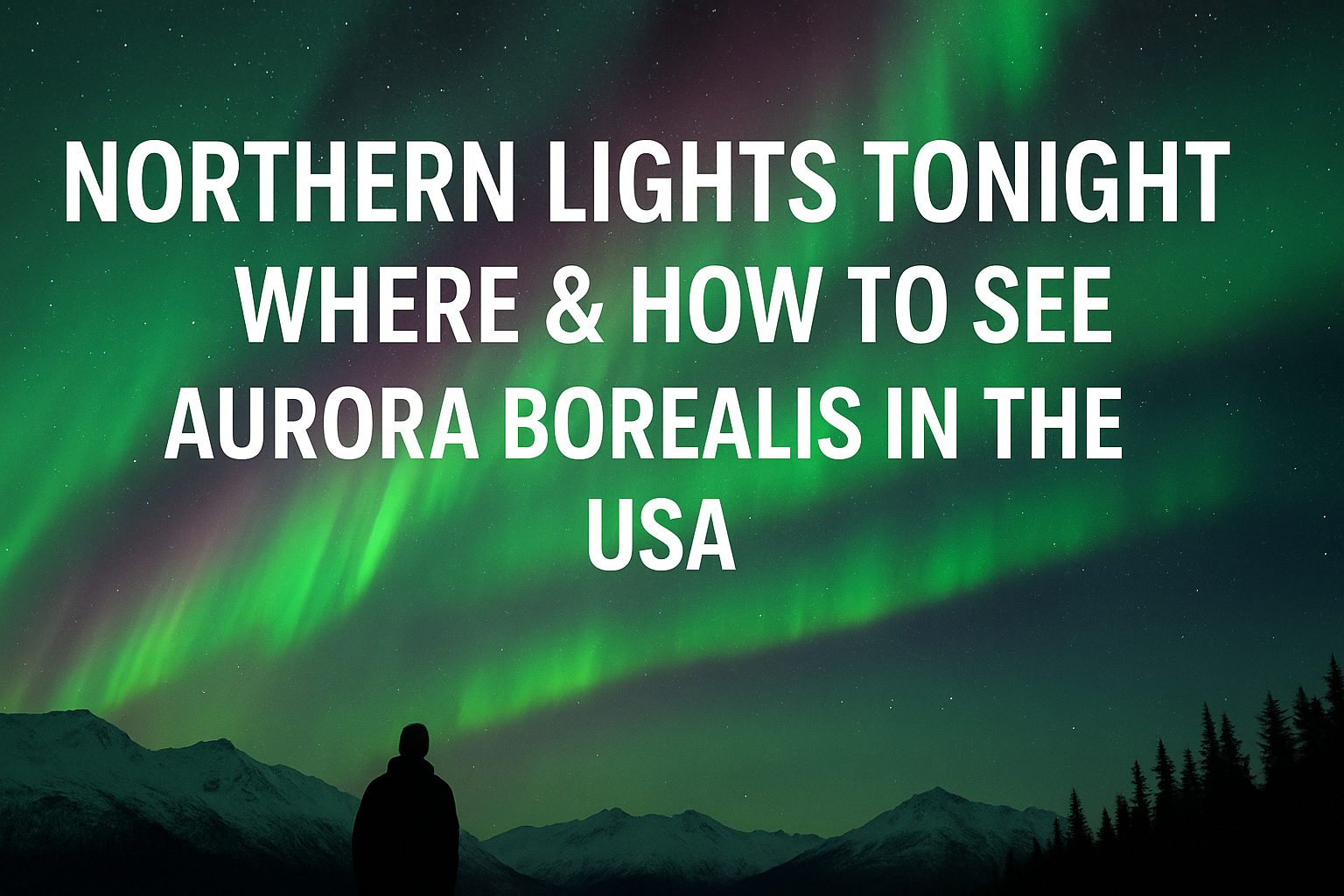
If you’ve ever seen photos of glowing green, purple, or even red waves lighting up the Arctic night sky, that’s the aurora — also known as the Northern Lights (Aurora Borealis) in the north or Southern Lights (Aurora Australis) in the south. It’s one of the most breathtaking natural phenomena on Earth, combining science, space weather, and a touch of magic. For travelers, photographers, and astronomy enthusiasts alike, seeing the aurora is a bucket-list experience.
🌞 The Science Behind the Aurora
The aurora is caused by a fascinating interaction between the Sun and Earth’s magnetic field. Every second, the Sun releases streams of charged particles known as the solar wind. These particles travel millions of miles through space and eventually collide with Earth’s magnetic field, which guides them toward the polar regions.
When these particles enter the upper atmosphere, they collide with oxygen and nitrogen molecules. These collisions excite the molecules, and as the molecules return to their normal state, they release energy in the form of light. This is what we see as shimmering bands or curtains of light dancing across the sky.
🎨 Why Do Auroras Have Different Colors?
The colors of the aurora depend on both the type of gas and the altitude of the collisions:
- 💚 Green – produced by oxygen molecules at around 60 miles above Earth, and it’s the most common color.
- ❤️ Red – comes from oxygen higher up, above 150 miles, and appears during stronger geomagnetic storms.
- 💜 Purple or Blue – caused by nitrogen molecules lower in the atmosphere.
Occasionally, you might even see pink or yellow hues, depending on the combination of gases and the intensity of the solar wind.
🌍 Where and When Can You See the Aurora
In the Northern Hemisphere, auroras are most commonly visible in Alaska, Canada, Iceland, Norway, Sweden, and Finland. For the Southern Hemisphere, the aurora australis can be seen in parts of Antarctica, New Zealand, and Tasmania, Australia.
The best time to see the Northern Lights is usually from late September to March, when the nights are longer and darker. Solar activity also plays a role: periods of high solar storms increase the likelihood of intense auroras.
Tip: To maximize your chances of seeing the aurora, check real-time aurora forecasts. The NOAA Ovation Map and apps like AuroraWatch track geomagnetic activity and predict visibility based on the Kp index, a measure of geomagnetic storm intensity. A higher Kp number means the aurora can be seen farther south from the poles.
🛰️ How Auroras Affect Technology
Auroras are more than just beautiful lights; they are a visual indicator of space weather, which can impact modern technology. During strong geomagnetic storms, auroras can:
- Disrupt radio communications
- Affect GPS navigation and satellite operations
- Induce electric currents in power grids, potentially causing outages
Scientists monitor solar wind speed, direction, and magnetic orientation (Bz values) to forecast aurora intensity and to protect critical infrastructure. So while chasing the lights, remember that each flicker is also a sign of the Sun’s influence on our planet.
✨ Experiencing the Aurora
Standing beneath an aurora is unforgettable. The sky shimmers, dances, and shifts in color, often with ribbons and curtains stretching across the horizon. People travel thousands of miles just to witness it. Unlike a regular sunrise or sunset, auroras are unpredictable — they can appear suddenly, last for a few minutes, and then vanish.
Here’s how to make the most of your aurora experience:
- Go somewhere dark – Far from city lights is essential for seeing the lights clearly.
- Bring patience – Auroras are unpredictable. Sometimes you’ll wait for hours, and other times they’ll appear within minutes.
- Dress warmly – Arctic nights are cold. Layer up with thermal clothing.
- Capture the moment – Use a tripod and manual camera settings for the best shots.
🗺️ Real-Time Aurora Forecasting
The OVATION Prime model, developed by Johns Hopkins University and used by NOAA, predicts aurora location and intensity 30–90 minutes in advance. It creates maps showing green ovals for normal activity and red ovals for strong activity. These forecasts help aurora chasers know where to look and when to expect the lights.
Remember: the aurora doesn’t need to be directly overhead to be visible. When bright enough, it can be seen up to 1,000 km away from its center.
💡 Fun Facts About the Aurora
- The aurora is not just pretty — it’s a sign of the Sun’s influence on Earth.
- Auroras have been observed as far south as Cuba and Utah during strong geomagnetic storms.
- Indigenous cultures in the Arctic often have legends about the lights, seeing them as spirits or omens.
- Auroras are visible after sunset and before sunrise; they disappear during daylight.
🌠 Final Thoughts
The Aurora Borealis is where science meets natural beauty. It’s a live display of space weather you can see with your own eyes — a reminder that Earth is part of a much larger cosmic system. Whether you’re watching from a remote lodge in Alaska, a quiet beach in Iceland, or following live maps online, the aurora is a show you’ll never forget.
So next time you see the forecast for the Northern Lights tonight, grab your camera, bundle up, and step outside. The night sky is about to put on one of its most spectacular shows — a celestial dance that has fascinated humans for centuries.